We started the Connectivity Lab at Facebook to see if we could develop a range of new technologies that would help accelerate the process of bringing connectivity to areas that don’t have access to internet infrastructure.
We’re focusing the research on laser and millimeter-wave (MMW) communications for terrestrial, high-altitude unmanned aerial vehicles (UAVs), and satellites. Laser and MMW technologies allow us to leverage large bandwidths of communications data and, in some cases, unlicensed spectrum. In one scenario, laser or MMW beams transmit data initially from a fiber point of presence gateway to a UAV, then from UAV to UAV until the backhaul they’ve created extends far enough to the desired location.
To make this work, the team custom-designed a gimbal to be used onboard UAVs. The gimbal had to swivel, be lightweight, and be aerodynamically appropriate for the job. The slideshow below shows various designs the team considered, the one they ultimately decided on, and a description of the final design.
The second configuration for consideration was an air-to-air or air-to-ground capable, elevation over azimuth spherical gimbal with a refractive telescope folded twice, and a three mirrors long-legs Coude (elbo-type) path fixed to the azimuth stage. The optical bench is situated in the stationary base.
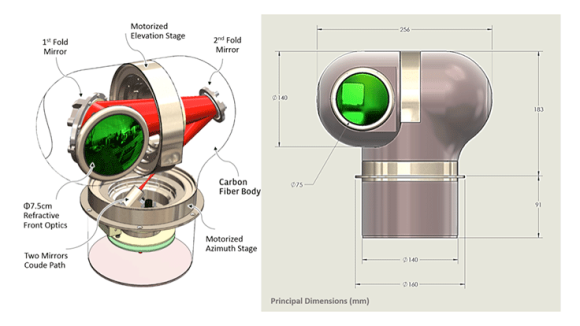
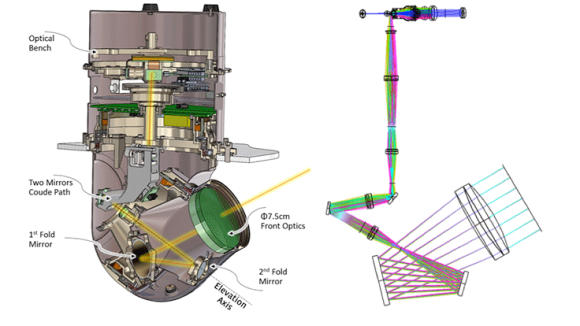
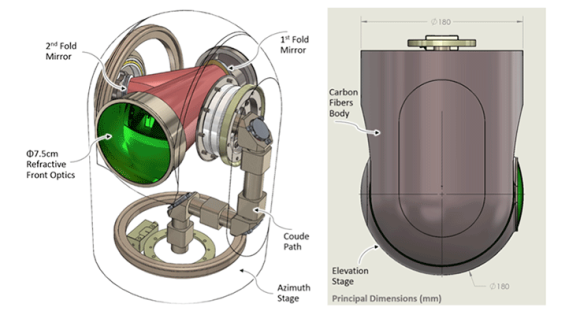
The third and final configuration considered was an air-to-air or air-to-ground capable gimbal with an elongated elevation stage over azimuth, refractive telescope folded twice, and a two mirrors miniature Coude path fixed to the azimuth stage. The optical bench is situated in the stationary base.
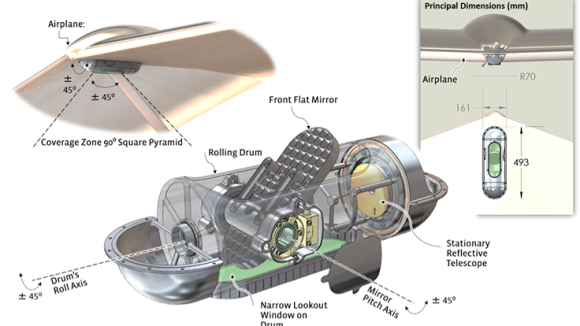
The initial configuration for consideration was an air-to-ground gimbal system with a stationary reflective telescope and two-axis motorized flat mirror in front of its aperture.
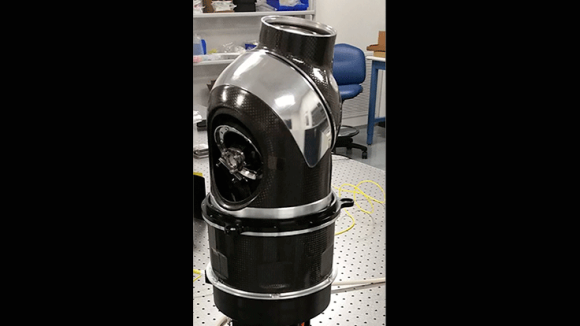
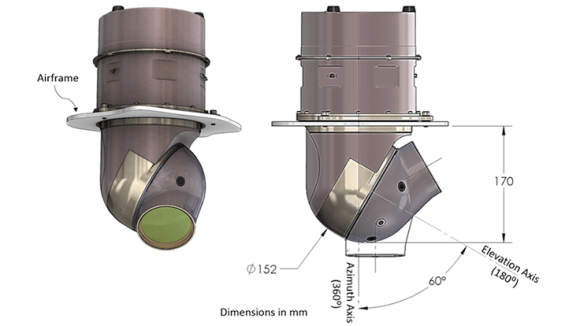
This is an operational prototype gimbal, complete with motors, encoders, and optics.
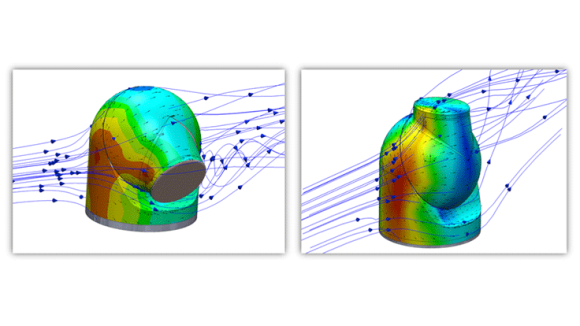
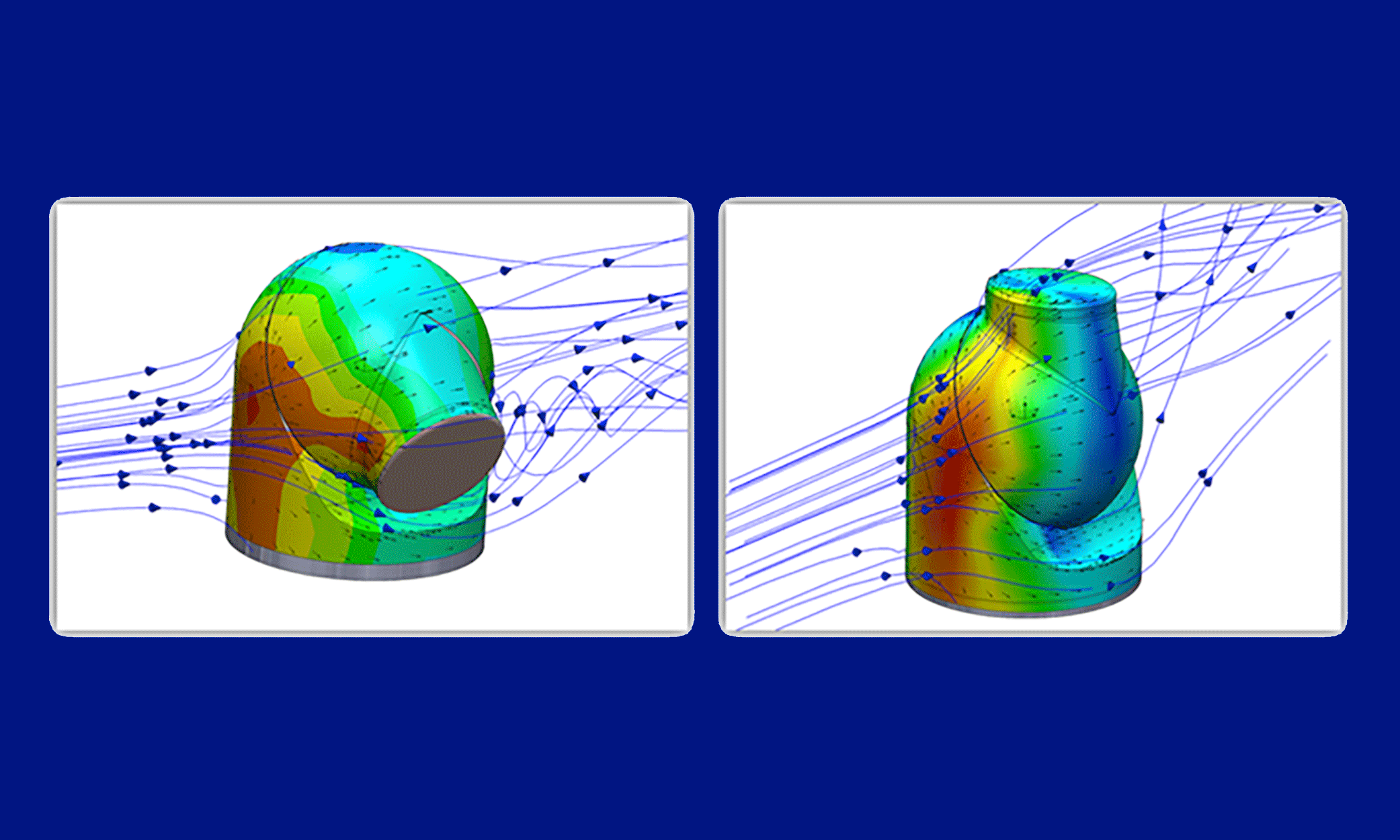
The gimbal design has symmetrical aerodynamic loading with a very low drag force and parasitic moments on the motorized axis.
This section view of the gimbal demonstrates the inner optical train and the modularity of the optical bench and the Coude path to be fitted differently for different missions.
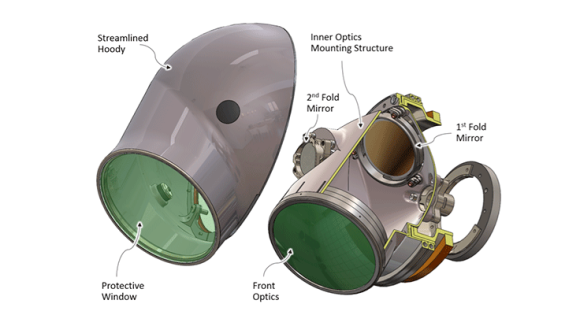
This is an exploded and partially cut view of the elevation stage.
The final gimbal configuration benefited from air-to-air and air-to-ground capability onboard a non-orthogonal elevation over azimuth small chassis, constructed of carbon fiber and magnesium composite.
This video shows the gimbal being tested in our lab. The state-of-the-art gimbal is made of carbon fiber and magnesium composite to keep the weight down to about 3.5 kilograms — and is at least two times lighter than the existing gimbal technology.
Meta believes in building community through open source technology. Explore our latest projects in Artificial Intelligence, Data Infrastructure, Development Tools, Front End, Languages, Platforms, Security, Virtual Reality, and more.
ANDROID
iOS
WEB
BACKEND
HARDWARE
Allow the use of cookies by Meta on this browser?
We (Meta Platforms Ireland Limited) use cookies on this site. Some of these are essential cookies which are required for the site to work as intended. We also use optional cookies to perform site analytics and measure the performance of content on this site. You have control over the optional cookies that we use. If you choose to "Decline optional cookies", you can continue to use the site but we will be unable to perform site analytics on this site using such cookies and similar technologies. Learn more about our cookies and third-party providers in our Cookies Notice, or review or change your choices at any time in your Settings page.